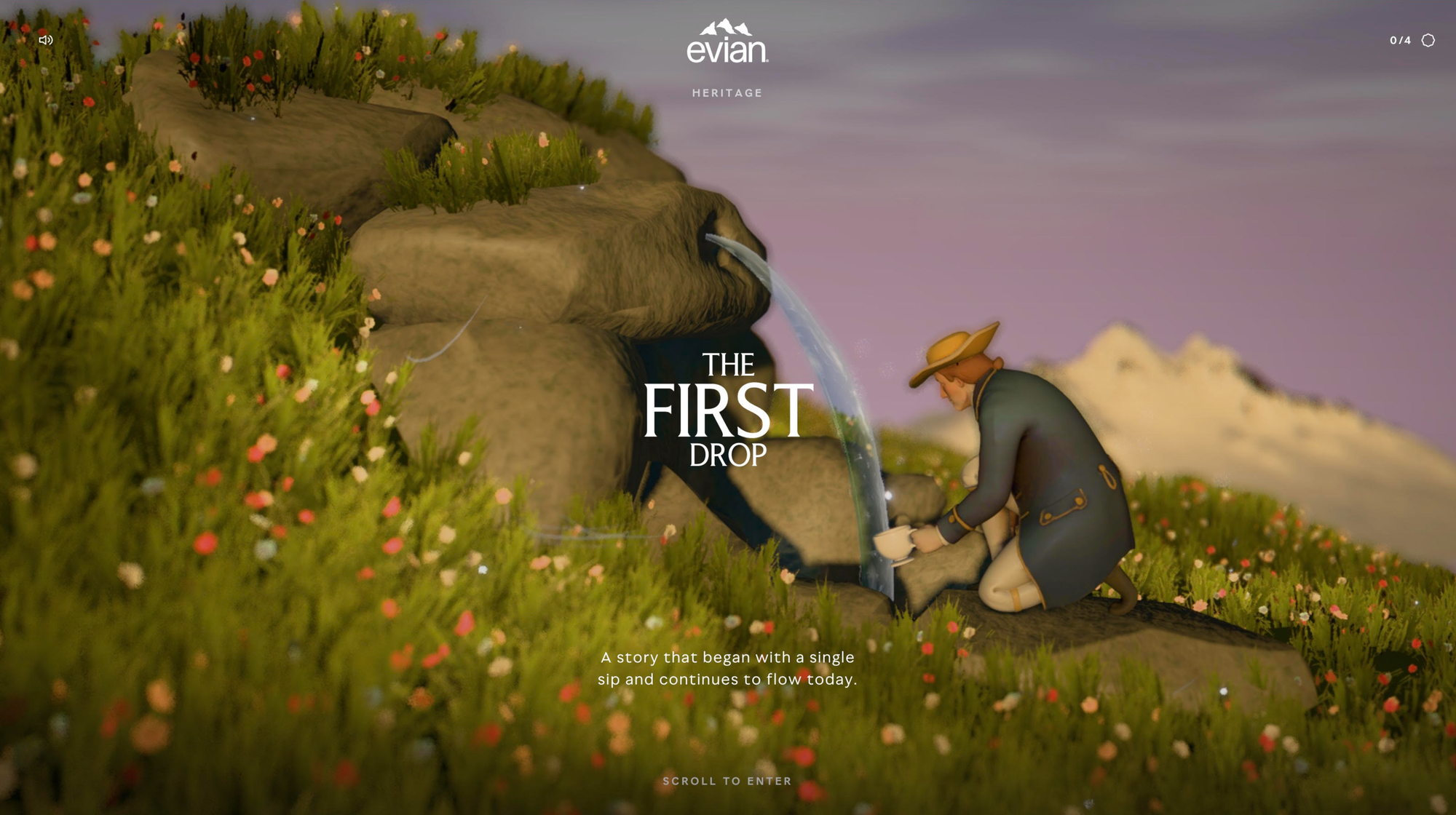
Evian turned its 200th birthday into an alpine world you can stand inside, and someone clearly decided the GPU should carry the whole thing. There's just too many details. If you look closely enough, you'll stare in awe seeing how the rain here doesn't just fall. It lands on the mountain peaks first, then a shallow-water sim shoves it downhill along the heightmap's pressure gradient, advecting it into channels until the slopes are streaked with the wet lines of actual runoff. Wind is a single shared idea: one world-space texture that the grass, trees, particles, the water stream, and a character's hat and jacket all read from, so everything leans the same way at the same instant. Weather rotates through snow, rain, and lightning that's generated fresh on every strike, so you'll never catch the same bolt twice, and the time of day bends along with it. It's the kind of scene where you stop "using" the site and just stand there watching the storm move across the valley.
It just keeps going.
Under the hood is where it gets quietly show-offy. The expensive lighting (SSGI, GTAO, fog) renders at half resolution with blue-noise-jittered samples, gets averaged clean across frames with reprojected history, then bilaterally upsampled so detail comes back without bleeding across silhouettes: cheap math, no smear. The 20,000 particles in the filtration scene never touch a mesh; they sample a baked 3D SDF and get pushed back out along its gradient, which turns collision into a texture lookup. Then there's GPU frustum culling with no CPU readback, a mosaic wall animated entirely from a vertex texture, and a render resolution that auto-scales to hold framerate and recovers slowly once the load eases. If GPU-driven everything is your wavelength, Ethan is worth a follow; he rebuilt the whole particle system here in the spirit of his earlier Monolith Project.
- Live Demo: https://celebrating200.evian.com
- Author: Ethan Chiu (X, LinkedIn, Awwwards)