Search the archive.
Find published work and reporting by title, description, article text or tag.
Refine results1
Also searching for Automotive, because “car” is another name for it.
Results 1 to 24 of 32 for “car”.
- Showcase
Holiday Snow Globe
Michael Modena's holiday snow globe uses WebGPU compute shaders to create volumetric snow that actually fills the dome with mesh-based particles generating proper normals. Plus a Porsche GT3 drifts inside. It's a Christmas card that doubles as a lighting and compute shader stress test.
- Showcase
BND Agency: An Agency Portfolio Built as a Showroom
Doan Bao Nam rebuilt the agency portfolio as a showroom you move through, not a page you scroll. Interactive 3D canvases and a custom audio-visual engine share a single frame, holding 60 FPS while sound and geometry run at once. Open devtools and watch how it stays steady.
- Showcase
Smooothy: A Slider Built to Sit Under Your WebGL Scene
Federico Valla's Smooothy is a tiny TypeScript slider that exists because every other carousel synced badly with WebGL. Drag through Toast and Fish but no Head while current, target, and parallaxValues tick out in real time, ready to feed your shader uniforms.
- Showcase
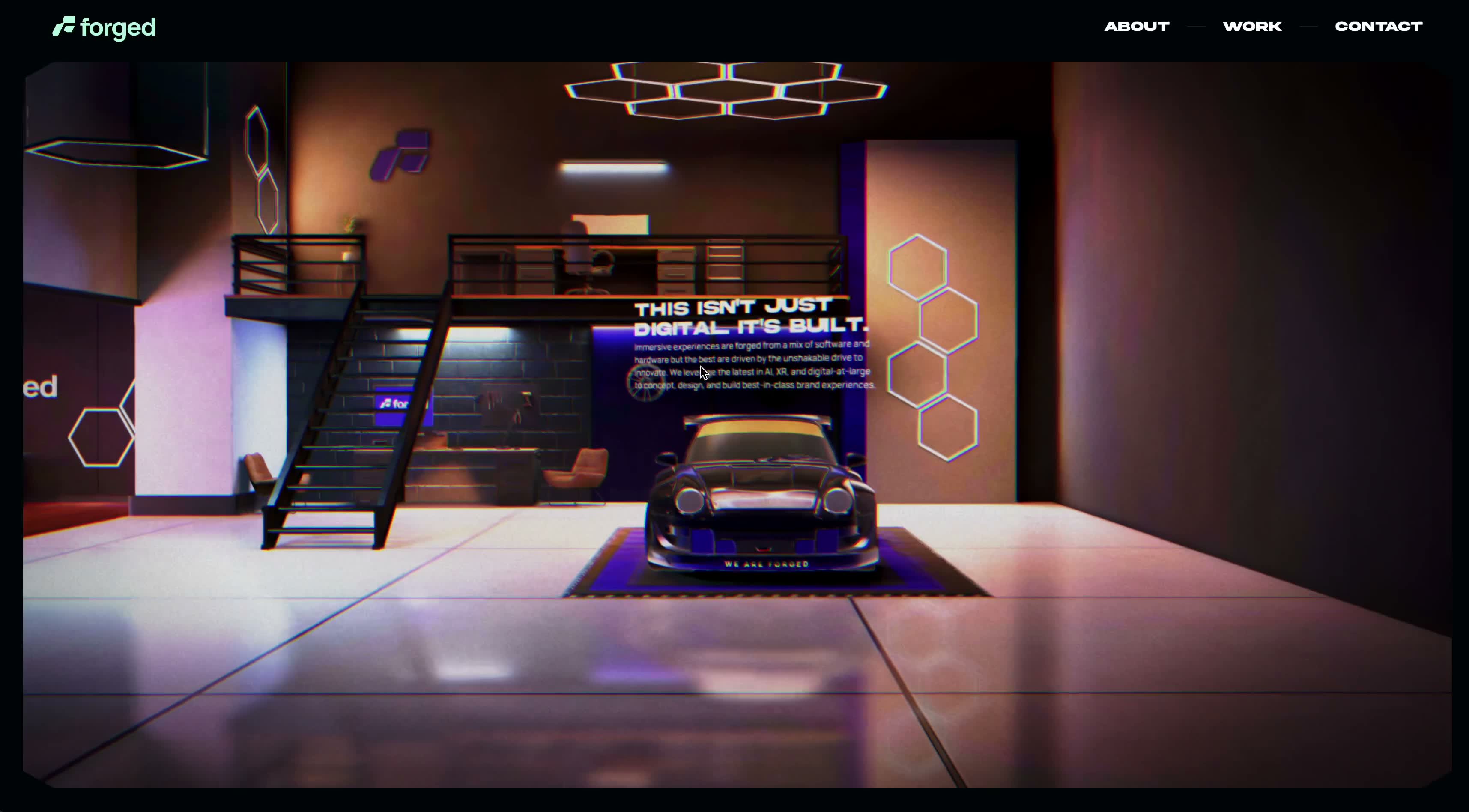
Forged.build
Forged.build turns a studio site into a cinematic 3D workshop built in WebGPU. Scroll through a real-time space with baked GI, dynamic highlights, and custom shaders. Built by Michael Modena to show what a small team can do with modern web graphics.
- Showcase
A React Three Fiber Portfolio That's Fluid
Scroll and the work sloshes. Toggle and a carousel snaps into an alphabetized grid, the whole 3D scene graph rearranging while the DOM shadows it underneath. Maxi Ruti built it in React Three Fiber and wired reduced-motion in from the start, so the ambition ships without the spinner.
- Showcase
A Project Gallery That Bends Like Film
A row of project cards behaves like a strip of film you can scroll, flex, and shove around with your cursor. Built in Three.js with hand-written GLSL, where scroll velocity drives a vertex-shader bend and a post-process pass adds the grainy, almost celluloid edge shimmer.
- Showcase
Find Your Way to Oz: The 2013 Chrome Experiment
UNIT9 built a full Kansas carnival in WebGL for Disney, then destroyed it with a tornado shader borrowed from neuroscience. No physics engine. No framework. Just clever faking, spatial audio, and a three-month deadline. The source is open.
- Showcase
Botanics: A Three.js Plant Study
Plantlike forms in a browser tab, no loops or cheap wiggle in sight. Sujen Phea's Three.js scene leans on instancing, careful shaders, and a scene budget that stays out of its own way. Open it, let it run, and see how long before you remember to close it.
- Showcase
DRIFT: A Million Particles, a Lost Astronaut, and AI-Generated Loneliness
A lost astronaut records his diary in your browser. Over a million GPGPU particles shift with his mental state while AI generates fresh text and voice each visit. Ming Jyun Hung built something that feels alive and a little heartbreaking.
- Showcase
In The Clouds: Tallest Buildings as 40-Meter Blocks
The world's tallest buildings rendered as stacked 40-meter blocks in Three.js. One block equals four floors. Pure client-side WebGL with procedural geometry. No map tiles, just height data and math.
- Showcase
Real-Time Naval Combat in the Browser with Rust, WASM, and WebGL
Multiplayer warship battles running entirely in WebGL. 43 ships, torpedoes, submarines, aircraft carriers, and a custom Rust-to-WASM engine. No install. Just water and explosions. Open source.
- Showcase
Expeditione: A 1MB Landing Page and 4MB Educational Experience Built in Three.js
Stylized 3D dioramas that teach history, geography, and science. The landing page runs at 1MB. The Soil expedition packs 200+ images, 15+ models, and 10+ animations into 4MB. Vanilla Three.js, custom GLSL, zero ads. Proof that educational web experiences don't need to be bloated.
- Showcase
Deferred Rendering in WebGPU: Sponza with 400+ Compute-Driven Point Lights
Georgi Nikolov's WebGPU renderer puts 400+ point lights in the classic Sponza atrium. Deferred shading, cascaded shadows, Hi-Z reflections, TAA. Clean architecture that handles WebGPU's explicit pipelines without drama.
- Showcase
Liminal Blends Two Paths Into One WebGL Visual
Manish Dhaka’s Liminal is a compact WebGL visual experiment about blending two different paths into a seamless shared transition.
- Showcase
Shining Turns WebGPU Into A Small 3D Storybook
Chanwoo Hwang’s Shining is a short 3D interactive storybook built with Three.js WebGPU, using pages, light, and spatial scenes as the interface.
- Showcase
Dev From 2047: A WebGPU Portfolio Experiment in Vue and TSL
A shelved WebGPU portfolio experiment from LUCERRÁ. Vue and Theatre.js sequence the camera, TSL handles shader transitions, and the whole thing reads as choreography rather than layout. The version that did not ship, which is usually where the more interesting code lives.
- Showcase
IVRESS by Utsubo: A WebGPU Story That Refuses Light
A lone traveler in a world that refuses light. Built on Three.js's WebGPURenderer with a WebGL fallback and TSL shaders running on both backends. Utsubo's brand site for IVRESS reads like a short film, and the CTO behind it maintains the WebGPU side of three.js itself.
- Showcase
ChartGPU: WebGPU-Powered Charts That Hold Up at a Million Points
A WebGPU charting library that pans and zooms a million points without blinking. LTTB downsampling runs as a compute shader, hit-testing is GPU-accelerated, and each series ships as a single instanced draw. Line, area, bar, scatter, pie, candlestick. 97% TypeScript, 3% WGSL, MIT-licensed.
- Showcase
Pixel Vault: An Immersive Creative Marketplace from 2047
Pixel Vault drops you into a WebGL-rendered creative marketplace set in 2047. Bold geometry, fluid motion, and an interface that is the 3D layer, not decorated by it. Built by Karan Chouhan and Harshit Kumar Sahu, it's part storefront, part environment, and entirely worth exploring.
- Showcase
LFM2-MoE: An 8.3B Parameter Language Model Running Entirely in Your Browser via WebGPU
Liquid AI's LFM2-MoE loads 8.3B parameters (1.5B active) and generates text client-side through WebGPU. No server, no API key. A hybrid convolution-attention architecture running Mixture-of-Experts inference in a browser tab, powered by Transformers.js.
- Showcase
Martin Laxenaire's Portfolio Is a WebGPU Game Built on His Own Engine
Martin Laxenaire turned his portfolio into a playable WebGPU experience powered by gpu-curtains, his own 3D engine. Procedural particles, boids, and invoice-sized spheres unlock as you interact. Full source code and a Codrops breakdown included.
- Showcase
Penderecki's Garden: A Point-Cloud Memorial Built Using Photogrammetry
Huncwot turned billions of drone-captured particles into a navigable WebGL garden for composer Krzysztof Penderecki. Custom GLSL shaders breathe with the music. Fully keyboard-accessible. One of the most ambitious Three.js projects we've seen.
- Showcase
CHILE20: Active Theory's Three-World WebGL Campaign for Adidas Originals
Active Theory built three scroll-driven WebGL worlds for adidas CHILE20, each with its own visual identity. 500K-poly garments baked down to mobile-friendly meshes, fluid cross-world transitions, and a lockdown-era campaign that still holds up.
- Showcase
WebRF: The Longley-Rice Radio Propagation Model, Running in WebGPU Compute Shaders
Roman Liutikov ported the Longley-Rice ITM algorithm, a real-world radio propagation model used in cell network planning, entirely into WebGPU compute shaders. 1,200 lines of WGSL, a two-pass radial sweep architecture, and coverage maps that actually respect terrain.