Search the archive.
Find published work and reporting by title, description, article text or tag.
Refine results1
Also searching for Typography, because “text” is another name for it.
23 results for “text”.
- Showcase
spark.js GLTF Demo: Real-Time Texture Transcoding for Faster Asset Delivery
A GLTF viewer that ships textures as compact WebP or AVIF, then transcodes them to GPU-compressed formats in the browser. Small downloads, efficient VRAM. Spark.js handles the conversion so you get the best of both worlds.
- Showcase
curtains.js: DOM-Driven WebGL Textured Planes
Martin Laxenaire's lightweight WebGL library that converts HTML elements into shader-driven textured planes positioned exactly where your CSS says they should be. Write normal markup, add shaders, skip the coordinate math.
- Showcase
Ameen Abdullah's Portfolio Turns the Browser Into a Stage
A WebGPU sakura scene anchors the hero, Vue drives the page, and a second WebGL layer paints mini scenes into textures aligned with the DOM. Off-screen blocks pause their work. Subtitles arrive in Japanese. A portfolio that behaves like a place rather than a CV.
- Showcase
Evian's Bicentennial WebGPU World, Where Rain Runs Downhill
Evian's 200th turned into an alpine scene that hands everything to the GPU: rain that lands on peaks and streaks down the slopes, one wind texture every object obeys, lightning generated fresh on each strike, and 20,000 particles colliding against an SDF instead of meshes.
- Showcase
Shader Lab: Stack, Animate, and Export GPU Shaders in the Browser
A layered shader compositor that runs on WebGPU. Stack gradients, text, and TSL passes, then bend them through a CRT layer that models phosphor smear and channel convergence. Write shaders as node graphs, keyframe the knobs, and export the whole thing into React.
- News
Google Introduces HTML-in-Canvas API: Accessible UI Meets WebGL / WebGPU
At Google I/O 2026, Chrome engineer Thomas Nattestad unveiled the HTML-in-Canvas API, which is a new web platform feature that lets developers render HTML elements directly into canvas, WebGL, and WebGPU contexts while preserving accessibility and interactivity.
- Showcase
Crystal Words: A Snowflake for Every Word You Type
Type a word. Watch it break into a six-fold ice lattice and hang in the air like a frozen sentence. Crystal Words is a small WebGL piece by Ming Jyun Hung that grows a structurally unique snowflake from whatever you put into the keyboard.
- Showcase
MasterSelects: A GPU-First Video Editor Built Entirely on WebGPU
A full video editor running in the browser with zero CPU roundtrip. 37 blend modes in one WGSL shader, GPU-accelerated scopes, optical flow scene detection, and SAM2 segmentation on-device. 13 dependencies. MIT licensed.
- Showcase
Aurelia: Fully Procedural Jellyfish with WebGPU
A real-time procedural jellyfish built with Three.js WebGPURenderer. Bell contractions, verlet tentacles, and iridescent shaders are all generated on the fly in TSL. No baked textures, just pure GPU compute.
- News
Chrome 149-150 Brings Immediates to WebGPU
Chrome 149-150 adds WebGPU immediates, tightens transient attachment validation, and continues Dawn cleanup work. Small changes, but useful ones for developers pushing many tiny per-draw updates.
- Showcase
Semantic Globe: A WebGPU Earth That Understands Plain English
Type a vibe like "somewhere cold and lonely" and watch a 3D Earth pin the answer. The text embeddings and the planet shaders share one GPU in one browser tab, no server in the loop. Joshua Lochner's quiet flex of what WebGPU can do when nobody is looking.
- Showcase
LFM2-MoE: An 8.3B Parameter Language Model Running Entirely in Your Browser via WebGPU
Liquid AI's LFM2-MoE loads 8.3B parameters (1.5B active) and generates text client-side through WebGPU. No server, no API key. A hybrid convolution-attention architecture running Mixture-of-Experts inference in a browser tab, powered by Transformers.js.
- Showcase
gpu-curtains: A WebGPU 3D Engine That Syncs Shaders to Your DOM
Martin Laxenaire rebuilt his DOM-to-shader library for WebGPU, and this time it's a full 3D engine. Lights, shadows, compute shaders, glTF support, and the same trick that made curtains.js useful: your HTML elements become shader geometry that scrolls and resizes like native DOM.
- Showcase
WebHeat: GPU-Powered Thermal Simulation for Any STL File
A high school senior learned Newton's law of cooling in class, then built a full thermal simulation in the browser. Drop in any STL, watch heat propagate through voxelized geometry on the GPU. WebGPU compute shaders, React frontend, and a useRef trick that keeps it all from falling apart.
- Showcase
WebGPU Water Simulation: Porting a Piece of Graphics History
The 2011 demo that helped inspire Figma gets a WebGPU rewrite. Ripples, caustics, raytraced reflections, and a bobbing sphere, all running on modern GPU APIs. Yong Su's port is a case study in what it takes to cross the WebGL-to-WebGPU bridge.
- Showcase
The Globe of Economic Complexity: Visualizing $15 Trillion in World Trade
Harvard's WebGL experiment animates 153,000 particles to map global exports. Each dot = $100M. Built with Three.js, it's a masterclass in data viz that's begging for a modern remake with up-to-date capabilities and data.
- Showcase
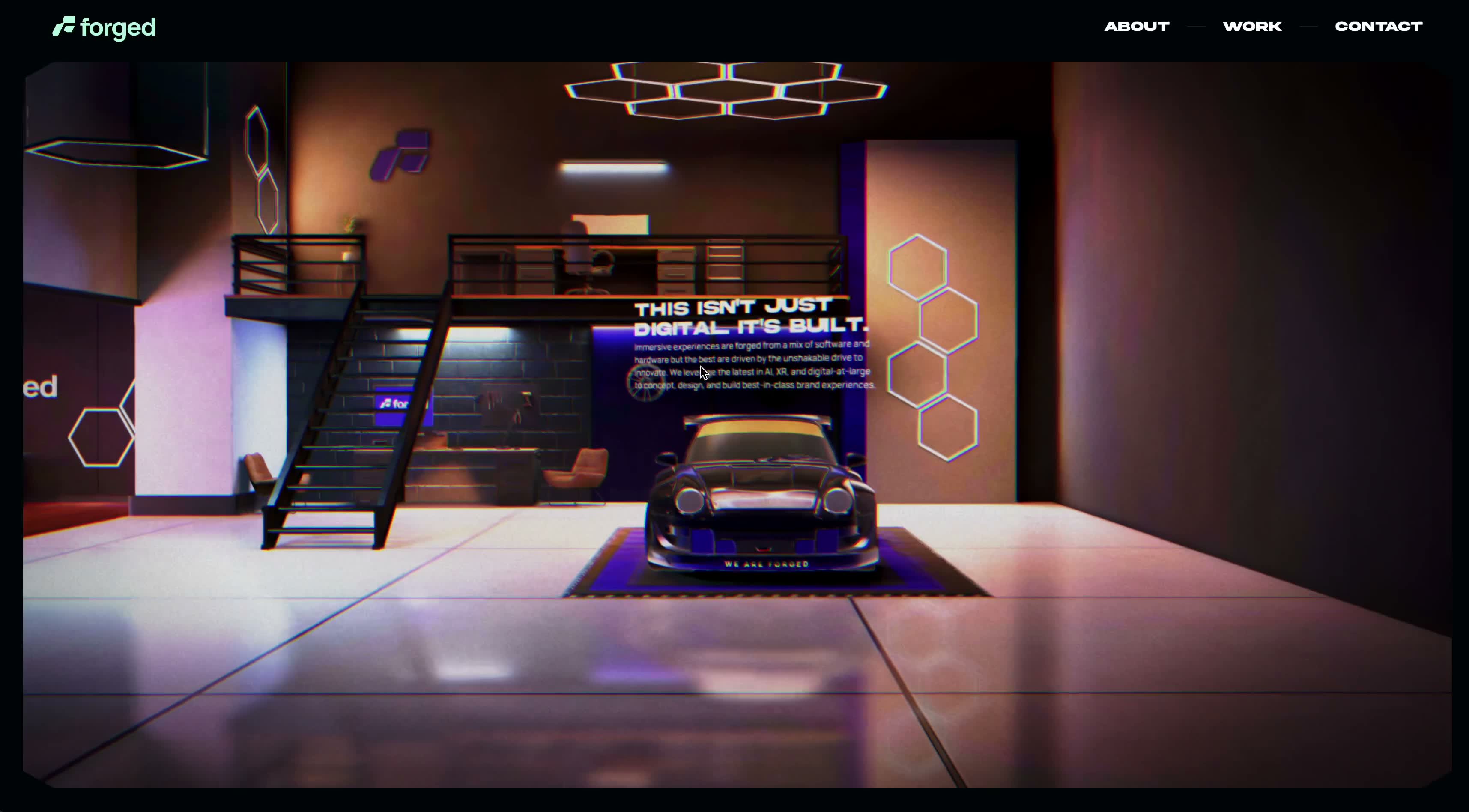
Forged.build
Forged.build turns a studio site into a cinematic 3D workshop built in WebGPU. Scroll through a real-time space with baked GI, dynamic highlights, and custom shaders. Built by Michael Modena to show what a small team can do with modern web graphics.
- News
WebGPU Hits Critical Mass: All Major Browsers Now Ship It
Chrome, Firefox, Safari, and Edge all ship WebGPU by default. Eight years of spec work finally pays off. Here is what changed, where the gaps remain, and why this matters for graphics and compute on the web.
- News
glTF 2.1 Aims At Complex Scenes, Not Just Single Assets
Khronos is planning glTF 2.1 as a backward-compatible update focused on large composed scenes, external assets, packaging, BVHs, thumbnails, and 64-bit GLB files.
- Showcase
Patina Preview: Real-Time Procedural Weathering in Three.js and TSL
A small procedural PBR playground by codetaur where metal ages in real time. Oxidation pools in the cavities, highlights dull from mirror to milk, and the whole surface rewrites itself through a Three.js TSL node graph running on WebGPU.
- Showcase
False Earth: A GPU-Driven Procedural Planet Built with WebGPU, TSL, and Three.js
An astronaut walks an alien planet that responds to every step. Over 1M grass blades, procedural terrain, and VAT-animated roses, all running in the browser via WebGPU compute shaders, TSL, and React Three Fiber.
- Showcase
Gen-02 Portfolio: An Immersive World
Samsy transforms the traditional portfolio into a 3D navigable space with his Gen-02 site. Built with Vue.js, GSAP, and custom WebGL, visitors explore interactive rooms showcasing a decade of award-winning creative tech work. Awwwards SOTD winner with serious technical depth.
- Showcase
CodeofSagar: 3D Animated Portfolio
Sagar Kumar Ghosh built a 3D portfolio that feels more like an interactive scene than a resume. It runs on React, Three.js, GSAP, and even dips into WebGPU. If you're curious how to blend real-time graphics with a modern web stack, this is worth a close look.