Search the archive.
Find published work and reporting by title, description, article text or tag.
Refine results1
Also searching for Space, because “galaxy” is another name for it.
20 results for “galaxy”.
- Showcase
Real-Time Global Illumination in the Browser With SATORI Engine
A WebGPU renderer where light actually bounces. Color bleeds across walls, reflections fade off the frame, and the sun slides overhead while exposure holds steady. Built on TSL nodes with a single MRT pass feeding screen-space GI and reflections. Open the GUI and break something.
- Showcase
SuperSplat: Editing 3D Gaussian Splats in the Browser
A few million ellipsoids that snap into a photoreal coffee shop, an ant, the Moon. SuperSplat is a browser-based editor for cleaning up 3D Gaussian splats, with GPU-accelerated selection, unlimited undo, and a streamed LOD format for massive scenes. Open source, nothing to install.
- Showcase
Semantic Globe: A WebGPU Earth That Understands Plain English
Type a vibe like "somewhere cold and lonely" and watch a 3D Earth pin the answer. The text embeddings and the planet shaders share one GPU in one browser tab, no server in the loop. Joshua Lochner's quiet flex of what WebGPU can do when nobody is looking.
- Showcase
Crystal Words: A Snowflake for Every Word You Type
Type a word. Watch it break into a six-fold ice lattice and hang in the air like a frozen sentence. Crystal Words is a small WebGL piece by Ming Jyun Hung that grows a structurally unique snowflake from whatever you put into the keyboard.
- Showcase
False Earth: A GPU-Driven Procedural Planet Built with WebGPU, TSL, and Three.js
An astronaut walks an alien planet that responds to every step. Over 1M grass blades, procedural terrain, and VAT-animated roses, all running in the browser via WebGPU compute shaders, TSL, and React Three Fiber.
- Showcase
Gen-02 Portfolio: An Immersive World
Samsy transforms the traditional portfolio into a 3D navigable space with his Gen-02 site. Built with Vue.js, GSAP, and custom WebGL, visitors explore interactive rooms showcasing a decade of award-winning creative tech work. Awwwards SOTD winner with serious technical depth.
- Showcase
Singularity: A Black Hole Simulation
A fully raymarched black hole in your browser (glowing accretion disk, gravitational lensing, radiation noise) all built with Three.js, TSL, and WebGPU. No geometry, just math. A cosmic shader experiment pushing real-time web graphics to the edge.
- News
Chrome 149-150 Brings Immediates to WebGPU
Chrome 149-150 adds WebGPU immediates, tightens transient attachment validation, and continues Dawn cleanup work. Small changes, but useful ones for developers pushing many tiny per-draw updates.
- Showcase
LFM2-MoE: An 8.3B Parameter Language Model Running Entirely in Your Browser via WebGPU
Liquid AI's LFM2-MoE loads 8.3B parameters (1.5B active) and generates text client-side through WebGPU. No server, no API key. A hybrid convolution-attention architecture running Mixture-of-Experts inference in a browser tab, powered by Transformers.js.
- Showcase
WebHeat: GPU-Powered Thermal Simulation for Any STL File
A high school senior learned Newton's law of cooling in class, then built a full thermal simulation in the browser. Drop in any STL, watch heat propagate through voxelized geometry on the GPU. WebGPU compute shaders, React frontend, and a useRef trick that keeps it all from falling apart.
- Showcase
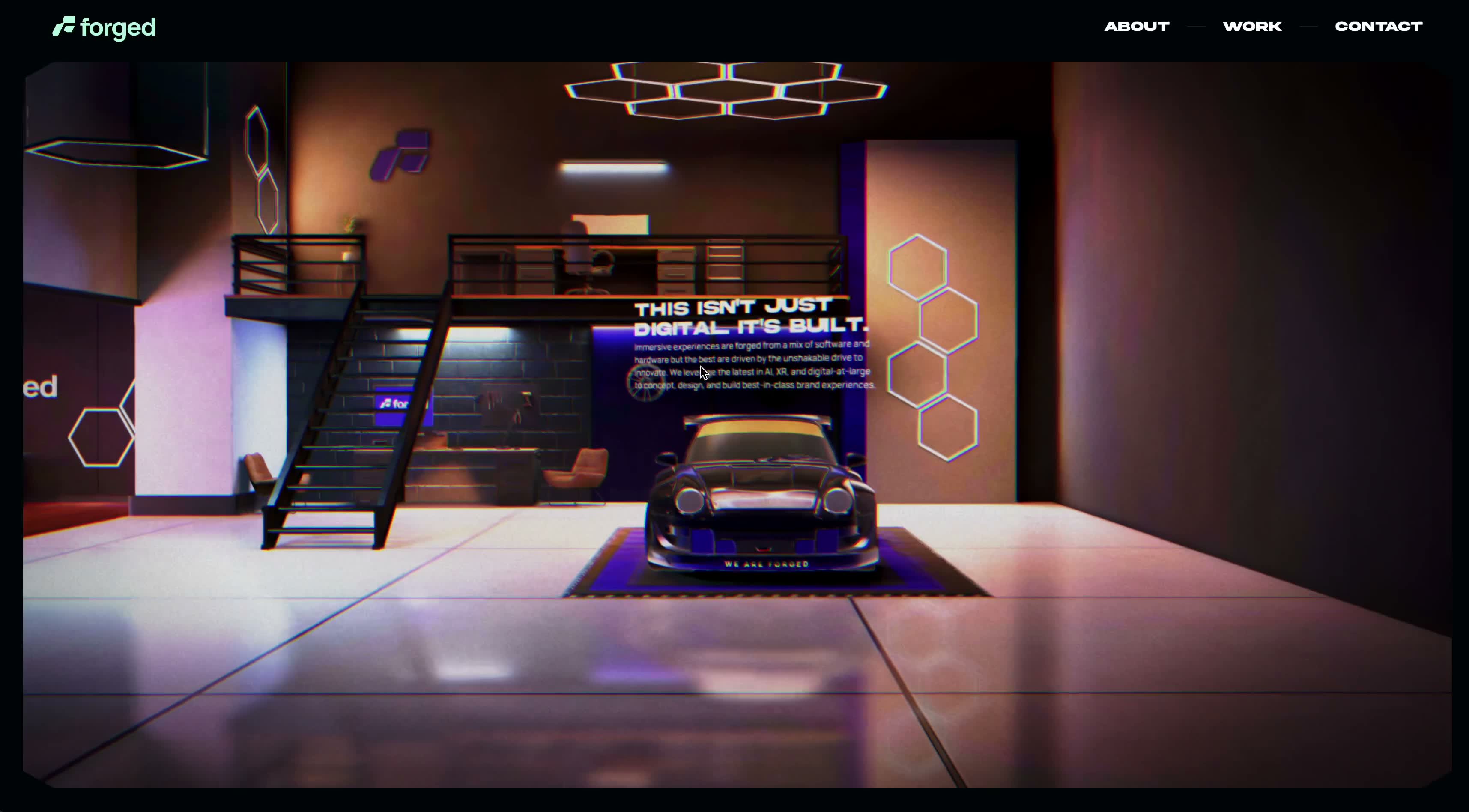
Forged.build
Forged.build turns a studio site into a cinematic 3D workshop built in WebGPU. Scroll through a real-time space with baked GI, dynamic highlights, and custom shaders. Built by Michael Modena to show what a small team can do with modern web graphics.
- Showcase
WebGPU Cluster Turns Browsers Into AI Inference Nodes
Alexsandro Souza’s WebGPU Cluster turns browser tabs into shared AI inference nodes, with WebGPU hosts running RF-DETR or SmolVLM behind a simple HTTP API.
- Showcase
Evian's Bicentennial WebGPU World, Where Rain Runs Downhill
Evian's 200th turned into an alpine scene that hands everything to the GPU: rain that lands on peaks and streaks down the slopes, one wind texture every object obeys, lightning generated fresh on each strike, and 20,000 particles colliding against an SDF instead of meshes.
- Showcase
Embedding Atlas: Apple's Open-Source Tool for Exploring Millions of Vectors in Your Browser
Apple's Embedding Atlas renders millions of embedding points interactively using WebGPU (with WebGL 2 fallback), Wasm-compiled UMAP, and density-based clustering that runs in milliseconds. Open source, with React, Svelte, Jupyter, and CLI support.
- Showcase
Game of 3D Life: Conway's Cellular Automaton with WebGPU
Conway's Game of Life in three dimensions. Simulation and rendering both run on the GPU via WebGPU compute shaders. No frameworks, just vanilla JS and hundreds of thousands of instanced cubes. Fly through the clusters as they evolve.
- News
WebGPU Meets Zero-Knowledge: Can Browser-Based Proving Finally Work?
zkSecurity integrated WebGPU compute shaders with StarkWare's Stwo prover and hit 5x speedups on constraint polynomial evaluation.
- Showcase
WebGPU Water Simulation: Porting a Piece of Graphics History
The 2011 demo that helped inspire Figma gets a WebGPU rewrite. Ripples, caustics, raytraced reflections, and a bobbing sphere, all running on modern GPU APIs. Yong Su's port is a case study in what it takes to cross the WebGL-to-WebGPU bridge.
- Showcase
Gauzilla Pro: Web-Native Gaussian Splatting for 4D Digital Twins
A browser-based platform turning drone footage and smartphone video into photorealistic 3D scenes with AI-powered segmentation. Built on an open-source Rust/WASM renderer, no installs required. Construction teams are already using it for as-built documentation.
- Showcase
Deferred Rendering in WebGPU: Sponza with 400+ Compute-Driven Point Lights
Georgi Nikolov's WebGPU renderer puts 400+ point lights in the classic Sponza atrium. Deferred shading, cascaded shadows, Hi-Z reflections, TAA. Clean architecture that handles WebGPU's explicit pipelines without drama.
- Showcase
Prinzipiell Tinker Series
Frank Reitberger’s Tinker series is a collection of WebGL and WebGPU experiments exploring procedural geometry, modular shaders, and real-time rendering in the browser. Each project builds on the last, offering sharp techniques and inspiration for anyone working with Three.js or TSL.